-
Rapid decreases in orders and production do not diminish expectations for the future.
-
Lower demand for resources leads to a decrease in inflationary pressure...
-
..., and supplier performance has improved for the first time ever recorded
In March, Romania experienced an intensified decline in its manufacturing sector, with businesses reporting worsening conditions across various aspects of the main PMI indicators. Both new orders and production levels dropped more steeply compared to the previous period, prompting companies to further reduce their staffing levels. Additionally, there was another reduction observed in inventory inputs, and on average, deliveries were quicker than before, indicating less strain on supply chain operations.
Positively speaking, lower demand for resources eased some of the pricing pressures. Additionally, faith in future production prospects improved.
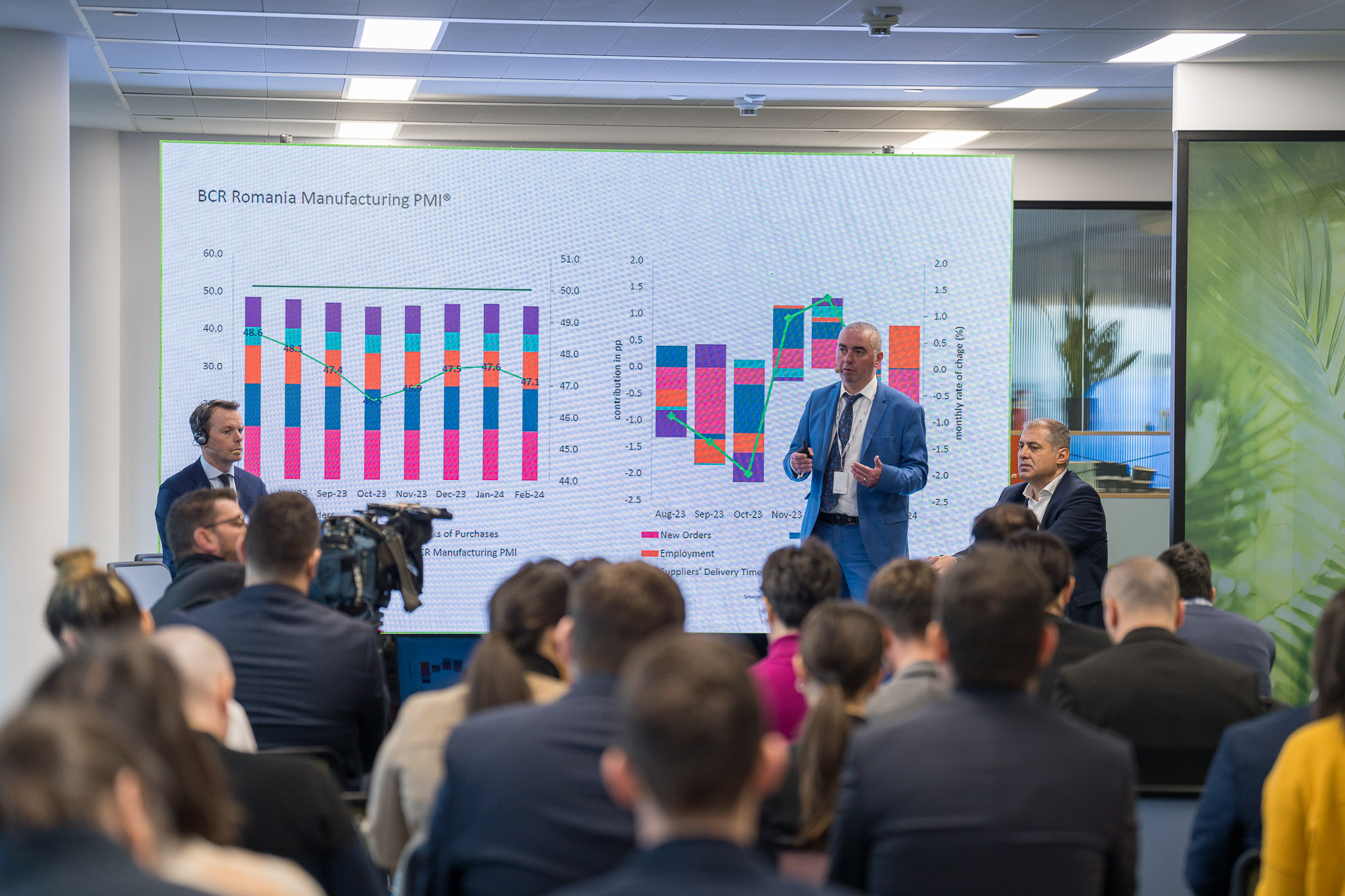
The BCR Romania Manufacturing PMI® headline represents an overall measure of manufacturing performance, distilled into a single figure using data from various metrics including new orders, production levels, workforce size, supplier lead times, and inventory levels of purchased materials.
In March, the headline index stood at 46.9, marking a decrease from February’s six-month peak of 48.3. The deterioration across the sector was widespread since each of the five PMI components contributed negatively to this trend.
Order book volumes continued to fall in the latest survey period, reportedly reflecting challenging demand conditions and tight customer budgets. Although new orders decreased at a faster rate on the month, the rate of contraction was in line with the series average.
Weighing on total sales, new work from customers in external markets dropped at a sharp pace and one that was the quickest seen over the opening quarter of 2025.
Meanwhile, manufacturing output in Romania kept declining, signaling the tenth successive month of reduced production. In this case, the pace of decline sped up significantly once again.
Other signals from the most recent BCR PMI survey likewise highlighted the frailty throughout Romania's manufacturing industry.
In March, the stock purchase index retreated back into negative territory following its first recorded month of growth in February. This decline occurred at an historically high pace. The decrease coincided with a significant drop in input purchasing, as companies frequently opted to use their existing inventories to meet production needs instead.
Concurrently, suppliers' delivery times, for which the index is inverted before entering the PMI calculation, shortened for the first time in the survey's history in March (albeit only slightly). The improvement in supplier performance reflected fewer instances of delays, better input availability and subsequently reduced pressure on supply chains.
Another way in which Romanian manufacturers looked to cut costs was by lowering staffing levels at their plants. This was achieved through the non-replacement of leavers and redundancies.
Backlogs of work nonetheless continued to decrease at a moderate and steady pace in the latest survey period. Panellists mentioned that excess capacity had allowed them to complete outstanding orders.
Turning to prices, there was a further hike in cost pressures faced by Romanian manufacturers in March. Suppliers had reportedly increased their prices and employment costs had crept up, according to anecdotal evidence. Although sharp, cost inflation eased to a rate in line with the series average.
Even with tougher operational challenges, Romanian producers expressed heightened confidence regarding upcoming production volumes. Their level of optimism reached its peak over the past nine months in March, driven by expansion strategies, promotional activities, and expectations of better economic scenarios.
Ciprian Dascalu, who leads economics at BCR, stated:
In March, the BCR Romania Manufacturing PMI slightly decreased to 46.9 from 48.3 recorded in the prior month. This indicates nine continuous months of decline within the Romanian manufacturing industry according to PMI survey findings. Every element contributed negatively during this period. Notably, for the initial time since records began, the supplier’s lead-time index surpassed the neutrality threshold. Accelerated deliveries were attributed to enhanced stocks held by suppliers possibly due to persistently low demand levels. Meanwhile, the HCOB Flash Germany Manufacturing PMI surged to a peak over two-and-a-half years high in March yet stayed below expansion territory at 48.3. External conditions appear increasingly favorable for growth in Romanian manufacturing, bolstered further by recent tax incentives introduced in Germany anticipated to benefit the segment positively.
The overall Purchasing Managers' Index (PMI) for the initial quarter suggests potential sequential decline in industrial output. According to official statistics provided by the National Institute of Statistics, January’s industrial output increased by 2.1%, showing strength month-over-month as well as year-over-year. Despite this robust performance, projected PMI numbers indicate that future quarterly data might pull down the mean growth rate. Expectations still point towards regaining positive momentum in industrial output by 2025 following two years of declines. Exports are expected to drive this recovery significantly.
Major expenditures within the EU focused on enhancing security, coupled with substantial financial incentives introduced in Germany aimed at infrastructure development and defense sectors, are anticipated to stimulate European manufacturing activities. Nonetheless, significant uncertainties persist, particularly concerning the proposed U.S. tariffs on automobiles. These impacts may ripple into Romania via indirect exposure through Germany’s automotive supply chains.
In March, new orders continued to contract, extending the downturn over nine consecutive months. Despite remaining within contraction territory, new orders showed considerable progress compared to the previous month. This trend suggests ongoing issues with demand within Romania’s manufacturing industry. Additionally, new export orders decreased further in March relative to February, pointing towards persistent challenges related to external market demands. Economic difficulties coupled with weak demand have led to a continuous decline in output, as indicated by PMI figures showing ten months of contractions so far. Similarly, employment levels, pending tasks, and inventories of completed products reflect the impact of reduced demand. Nonetheless, businesses maintain positive outlooks and their confidence metrics are currently surpassing long-term averages. Participants express optimism about potential improvements in economic circumstances and anticipate benefits stemming from earlier investments in marketing efforts and production capabilities.
In March, input costs kept increasing. Participants mentioned rising expenses from suppliers and, to a smaller degree, greater payroll expenditures. A portion of these additional costs was reflected in output prices, which likewise went up during the month. Compared to the prior month, the expansion pace slowed down for both input and output prices in March.
---
*This report is furnished by BCR Research .
No comments:
Post a Comment